
Emergency HVAC Services in Dubai: What Actually Happens When Your System Fails
It’s 2 AM, it’s July, and your AC just died. Or maybe it’s January and your heater picked the coldest night of the year to give up. Either way, you’re not thinking about warranties or maintenance schedules right now — you just want someone to show up and fix it. That’s the entire idea behind emergency HVAC services, and honestly, it’s a part of the trade that separates the companies who talk about customer service from the ones who actually deliver it.
At Fix On Click, we’ve picked up enough late-night calls to know that HVAC breakdowns never follow a schedule. A compressor doesn’t check the calendar before it burns out. A furnace doesn’t wait for business hours to short-circuit. So our approach has always been simple: be ready before the call comes in, not after.
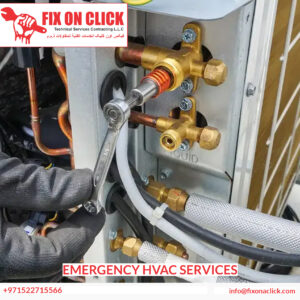
Why “Emergency” Means Something Different in HVAC Repair
People throw the word “emergency” around a lot, but in HVAC work it has a real meaning. It’s not just an inconvenient breakdown — it’s a situation where waiting even a few hours creates a genuine problem. Think about a Dubai apartment in August with no cooling. Or a clinic that needs stable temperatures for medication storage. Or an office building where a dead system means an entire workday grinds to a halt.
These aren’t situations where you can afford to “wait for an opening next Tuesday.” That’s the gap that Emergency HVAC Services exist to close, and it’s exactly where a lot of companies quietly fall short — either they don’t have the manpower on standby, or they simply don’t prioritize urgent calls the way they should.
The Difference Between Routine Service and a True Emergency Call
Standard HVAC maintenance is planned. You book a slot, a technician shows up, checks filters, tests refrigerant levels, maybe replaces a part or two, and leaves. It’s predictable, and that’s the point.
Emergency calls are the opposite of predictable. A technician might walk into a burnt-out control board, a cracked heat exchanger, a refrigerant leak, or a system that’s simply stopped communicating with itself. There’s no pre-diagnosis. The technician has to figure out the problem on the spot, with the tools and parts they’re carrying, and fix it there and then — not schedule a follow-up visit.
What Our Technicians Actually Carry Into an Emergency Job
A big part of responding fast is not showing up empty-handed. Our technicians carry diagnostic equipment, commonly needed replacement parts, and enough experience to make quick calls under pressure. A family sitting in a house with no AC in the middle of a heatwave isn’t interested in hearing that a part needs to be ordered and will arrive “sometime next week.”
That mindset — that delays simply aren’t an option — is what shapes how we train and equip every technician who takes an emergency shift.
Common Failures We Handle on Emergency Calls
- Compressor burnout or complete motor failure
- Frozen evaporator coils
- Electrical faults, tripped breakers, and wiring damage
- Refrigerant leaks causing sudden loss of cooling
- Thermostat and control board failures
- Complete system shutdowns with no visible cause
When Repair Isn’t Enough: Emergency Installations
Sometimes a system doesn’t just break — it’s beyond saving. A corroded furnace chamber, a compressor that’s fried beyond repair, or an electrical failure that’s damaged the unit permanently. In these cases, repair isn’t even on the table. What’s needed is a full replacement, and it’s needed fast.
This is where a lot of HVAC providers hit a wall, because same-day installation isn’t something you can improvise. It takes stocked inventory, supplier relationships that actually work, and a team trained to install a full unit correctly under time pressure — not just quickly, but correctly. We keep popular unit models in stock and maintain rapid-deploy teams specifically so that a full replacement doesn’t turn into a week-long wait.
Every connection gets tested. Every seal gets checked. Rushing an install just to “get it done” creates callbacks and, worse, safety risks. So even under time pressure, the job gets done properly the first time.
Why Same-Day Installations Are Harder Than They Sound
Coordinating a same-day HVAC installation involves more moving parts than people realize — matching the right unit to the space, confirming electrical compatibility, arranging transport, and having a crew available who isn’t already booked on another job. It’s a logistics problem as much as a technical one, and it’s exactly why we’ve built our operations around keeping stock on hand and teams ready to move.
The Health and Safety Side Nobody Talks About Enough
It’s easy to think of a broken AC or heater as just an inconvenience. But in extreme weather, it’s a genuine health risk. Loss of heating in freezing conditions can lead to frozen pipes and dangerously cold indoor temperatures. Loss of cooling during a heatwave can bring on heat exhaustion, dehydration, and serious complications — especially for children, elderly residents, and anyone managing a health condition.
This is why our dispatch team treats every urgent call with priority, routing it to the right technician based on the system type and the nature of the failure. We also walk customers through interim safety steps — sealing off certain rooms, using a portable unit safely, or other temporary measures — so there’s a plan in place even before the technician arrives.
Facilities Where Fast HVAC Recovery Isn’t Optional
- Clinics and healthcare centers
- Daycare centers and nurseries
- Assisted living and elderly care homes
- Homes with infants or residents managing chronic illness
60+ Vehicles, Every Area of Dubai, No Excuses
Here’s something that genuinely sets Fix On Click apart from a lot of the competition: we run a fleet of over 60 service vehicles dedicated to home maintenance work, positioned and ready to move across every part of Dubai. This isn’t a backup plan — it’s the backbone of how we deliver on the promise of “emergency” service.
When a call comes in from Jumeirah, Deira, Business Bay, Al Barsha, or anywhere in between, we’re not scrambling to figure out who’s nearby and available. Our fleet structure means a technician can be routed and on the road within minutes, not hours. That kind of coverage is expensive to maintain, and it’s exactly why so few providers actually match it — but it’s also the reason our customers get a real response time instead of a vague promise.
For us, this fleet isn’t a marketing line. It’s the practical reason we can say “24/7 emergency response” and actually mean it, no matter which corner of the city you’re calling from.
Round-the-Clock Availability: What That Actually Looks Like
“24/7” gets used loosely in this industry. For some companies it means an answering machine that promises a callback the next morning. For us, it means an actual person answering the phone at 3 AM, and a technician already being dispatched while you’re still on the call.
Our scheduling system is built to prioritize emergency requests over routine bookings, and our technicians work rotating shifts specifically so there’s always an active team on standby — not just during the day, but through nights, weekends, and holidays too.
How Dispatch Priority Actually Works
Every incoming call gets triaged. Emergency calls jump the queue immediately. From there, the nearest available vehicle from our fleet gets assigned based on the type of system and the nature of the fault, so you’re not waiting for a generalist when you need someone who specializes in that specific failure.
What Actually Separates a Good Emergency Provider From an Average One
Anyone can put “24/7 emergency service” on a website. Fewer companies can back it up when the phone actually rings at an inconvenient hour. At Fix On Click, the difference comes down to a few things that are easy to say but harder to consistently deliver:
- Technicians who show up already briefed and equipped, not figuring things out on arrival
- Honest timelines instead of inflated urgency or padded invoices
- Clear communication throughout the job, especially when parts or extra time are needed
- A fleet and staffing structure built around actual response speed, not just claims of it
We’ve found that customers remember how they were treated during a stressful moment far more than they remember the technical details of the repair. That’s why we put as much weight on communication and honesty as we do on the technical fix itself.
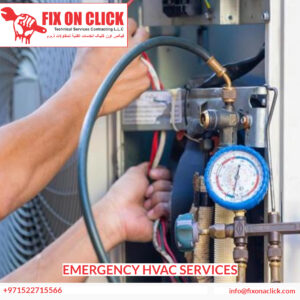
Why Preparedness Beats Panic
Most people don’t think about their HVAC system until it stops working — that’s just how it goes. But the smartest move you can make is having a provider saved in your phone before you actually need one. Save the number. Learn to spot the early warning signs — strange noises, weak airflow, a system that cycles on and off too often. And don’t wait for a full breakdown before scheduling a checkup. A little preparedness saves a lot of stress later.
Serving Every Corner of Dubai, One Emergency at a Time
From single-family villas to large commercial towers, we treat every call — big or small — with the same urgency. Our roots in this city run deep, and our reputation has been built call by call, not through advertising slogans. Every technician we send represents the company, and that’s a responsibility we take seriously. We don’t cut corners, and we don’t consider a job finished until the system is running safely and reliably.
Signs Your System Is Heading Toward an Emergency
Most breakdowns don’t happen completely out of nowhere. There are usually small warning signs in the days or weeks before, and catching them early can be the difference between a routine repair and a middle-of-the-night emergency call. Short cycling, where the system turns on and off more frequently than usual, is often an early red flag. So is a sudden spike in your utility bill without any change in usage — it usually means the unit is working harder than it should to hit the same temperature.
Unusual smells, especially a burning odor near the indoor or outdoor unit, should never be ignored. Neither should strange noises — grinding, clicking, or a rattling sound that wasn’t there before. Weak airflow from vents, uneven cooling or heating across rooms, and visible ice buildup on coils are all signs that something is wearing down. None of these guarantee a full breakdown is coming, but they’re worth a call to a technician before the system decides to fail on its own schedule.
Book an Emergency Visit or Explore Related Services
If your system has failed or is showing warning signs, don’t wait it out. You can check our full range of HVAC services for both repair and installation work, or reach out directly for immediate dispatch.
Frequently Asked Questions
How fast can Fix On Click respond to an emergency HVAC call in Dubai?
Thanks to our fleet of 60+ service vehicles positioned across Dubai, response times are typically much faster than standard scheduled appointments. The exact time depends on your location and current demand, but emergency calls are always prioritized over routine bookings.
Do you handle both residential and commercial emergency HVAC issues?
Yes. We respond to emergency calls for homes, offices, clinics, retail spaces, and large commercial buildings across Dubai, with technicians assigned based on the type of system and scale of the issue.
What if my HVAC unit needs full replacement instead of repair?
If a technician determines the unit is beyond repair, we can arrange same-day or urgent installation in many cases, since we keep popular unit models in stock and maintain teams specifically trained for rapid installs.
Is emergency HVAC service available at night and on weekends?
Yes, our emergency service operates 24 hours a day, seven days a week, including nights, weekends, and public holidays.
What should I do while waiting for the technician to arrive?
Our dispatch team will usually walk you through simple interim steps over the phone, such as sealing off certain rooms or safely using a temporary heating or cooling unit, depending on the situation.
Are emergency call-out charges higher than standard service visits?
Emergency dispatch does involve different pricing than a scheduled visit, since it requires immediate technician availability outside normal routing. Our team always communicates costs upfront before starting work, with no hidden charges added later.