
Short-Circuit Repair Service
A short circuit is not a fault you work around. It is an active electrical hazard that gets worse between the moment it occurs and the moment it is properly fixed. Whether it trips a single breaker repeatedly, kills power to an entire floor, or produces burning smells from inside a wall, the source needs to be found and corrected by someone with the right diagnostic equipment and the training to work safely inside a live electrical system. Fix On Click carries out short-circuit repair across all areas of Dubai, covering residential villas, apartments, townhouses, and commercial properties of all sizes.
Dubai's building stock ranges from structures built in the 1980s with wiring that has never been replaced to brand-new high-rise apartments where the fault is in a single junction box behind a finished wall. Both situations require the same disciplined approach: isolate, diagnose, trace, repair, test. Our technicians carry the equipment to locate faults non-invasively where possible, and the experience to interpret what the readings mean before opening anything. We do not arrive and start pulling out sockets hoping to find the problem.

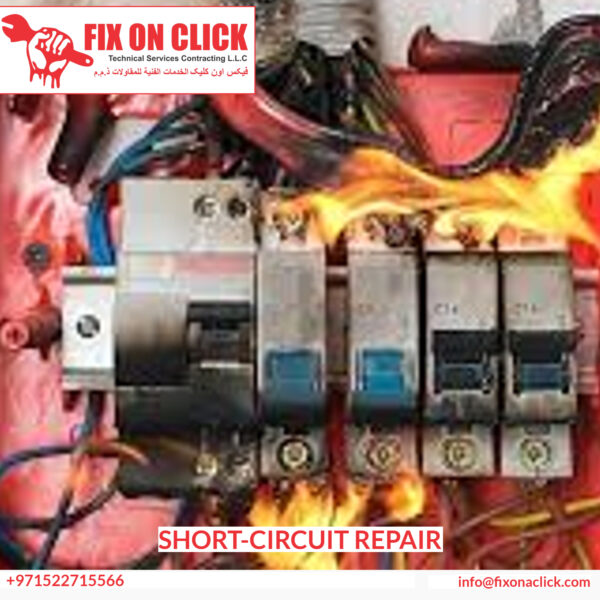
What Short-Circuit Repair Actually Involves
A short circuit happens when current takes an unintended path through a circuit, bypassing the load it was meant to power. The result is a sudden surge that trips breakers, blows fuses, or in the worst cases produces heat fast enough to ignite cable insulation or surrounding materials before any protection device can respond. Finding where that unintended path is requires a systematic diagnostic process, not guesswork.
In Dubai properties, short circuits most commonly originate from aged wiring insulation that has dried and cracked in the heat, connections inside junction boxes or back-boxes that have worked loose over years of thermal cycling, moisture ingress around air conditioning drainage points or kitchen areas, and in older buildings, wiring that was undersized for the actual load it has been carrying for years. We attended a villa in Umm Suqeim last year where a breaker had been tripping on the same circuit for eight months. The homeowner had replaced the MCB twice. The actual fault was a pinched wire inside a wall junction box behind a television unit, where the insulation had worn through against the edge of a metal mounting bracket. The MCB replacement had never addressed the fault.
Fix On Click technicians use insulation resistance testers, clamp meters, and circuit tracers to locate faults before opening walls or pulling cables. Measuring first means fewer unnecessary access points and a faster, cleaner repair.
Warning Signs
You Have a Short Circuit That Needs Attention
Short circuits rarely announce themselves with a dramatic event. Most develop progressively, giving clear signals well before they become a serious hazard. These are the ones to act on immediately.
Breaker Trips on the Same Circuit Repeatedly
A breaker that trips once after an overload and stays reset is doing its job. A breaker that trips again within hours or days of being reset, with no change in what is plugged in, is responding to a persistent fault on that circuit. Resetting it without finding the fault is not a repair — it is postponing the diagnostic work that needs to happen.
Burning Smell from a Socket, Switch, or Wall
The smell of burning plastic or hot metal from anywhere in the electrical system is a signal that something is getting hot that should not be. This is not a smell that resolves on its own. It points to a fault producing heat inside insulation, a back-box, or a junction point. The circuit in question should be isolated until the source is found and repaired.
Lights Flickering or Dimming Unexpectedly
Occasional flicker on a single lamp is usually a loose bulb or a failing fitting. Flickering across multiple lights on the same circuit, especially when a particular appliance is switched on, points to a wiring fault creating intermittent resistance or partial contact. This pattern is characteristic of a developing short circuit rather than a simple loose connection.
Scorch Marks or Discolouration Around Sockets
Visible scorching or brown discolouration on or around a socket face, switch plate, or cable entry point is evidence that arcing or overheating has already occurred at that location. The socket may still appear to function, but the damage to the internal connections and the plastic housing means the fault is ongoing, not historical.
Sparks When Plugging In an Appliance
A brief, small spark when connecting a high-draw appliance to a live socket is not always a fault. A spark that is large, sustained for more than a fraction of a second, or that occurs on appliances that have never caused this before, points to a wiring issue at that socket or on the circuit feeding it. This should be assessed rather than ignored.
Complete Loss of Power to One Area
When a section of a property loses power and the breaker does not trip, or trips but will not hold reset, the fault is typically a hard short somewhere on that circuit. Unlike an overload which a simple load reduction resolves, a hard short keeps the breaker from holding regardless of what is unplugged, because the fault is in the wiring itself rather than in a connected appliance.
Sockets or Switch Plates That Feel Warm
Electrical accessories should be at or close to room temperature during normal operation. A socket face or switch plate that feels noticeably warm when nothing is plugged in, or when only low-draw items are connected, means current is flowing somewhere it should not be at the connection point behind that accessory.
Old Wiring Not Inspected in Over 10 Years
Dubai's temperature extremes accelerate the degradation of cable insulation significantly faster than in temperate climates. Properties built before 2005 with original wiring that has not been inspected carry a higher-than-average risk of insulation failure developing into short circuits. An inspection identifies compromised sections before they produce a fault event rather than after.
Why Getting the Diagnosis Right Matters More Than the Repair Itself
The repair work on a short circuit is rarely the difficult part. Replacing a section of cable, a socket, or a connection point is straightforward when you know exactly what you are replacing and why. The difficulty — and the place where jobs go wrong — is in the fault-finding that comes before. A short circuit that is repaired at the wrong location leaves the actual fault in place. The breaker will trip again. The smell will return. The scorch will spread. We have attended properties where the same circuit had been worked on multiple times by different people without the fault being located, each visit adding new connections and access holes without resolving anything.
Proper diagnostic work uses instruments. An insulation resistance test across the affected circuit cables tells you whether the insulation between conductors has broken down, before you open a single socket. A clamp meter identifies which branch of a circuit is carrying abnormal current. A circuit tracer follows a cable route through walls without needing to open them along the entire run. These tools change what finding a fault looks like. It becomes a process of elimination driven by measurements rather than a process of inspection driven by visual access.
Instrument-Led Fault Finding
We test before we open. Insulation resistance testing, clamp metering, and circuit tracing locate the fault's position on the circuit before any access work begins. This means fewer holes in walls and ceilings, a faster repair, and certainty that the fault found is the fault causing the problem.
Proper Isolation Before Any Work
Every repair begins with confirmed isolation of the affected circuit and a live voltage test to verify the isolation is effective before touching any cable or connection. Working on a circuit assumed to be de-energised rather than confirmed dead is how electrical injuries occur.
Full Circuit Check After Repair
After the specific fault is repaired, we re-test the circuit under load before restoring it to service. This confirms the repair addressed the actual fault rather than a symptom of it, and that nothing else on the circuit is compromised that the original fault may have masked.
Distribution Board Assessment
When a circuit fault is repaired, we also check the distribution board for signs of heat damage, loose terminals, or MCBs that have tripped repeatedly and may no longer hold their rated trip current reliably. A damaged MCB that no longer trips at the correct current level is a safety issue independent of the circuit fault.
Clear Account of What Was Found
At the end of every job we explain what the fault was, where it was located, what was done to repair it, and whether anything else was identified that needs attention. You leave the job understanding what happened to your electrical system, not just that it is working again.
How It Works
Our Short-Circuit Repair Process
Every job follows a consistent sequence from first contact through to post-repair testing. The steps do not change regardless of the property type or fault complexity.
Contact Us
Call or WhatsApp with a description of what you are experiencing: which circuit is affected, what symptoms are present, and how long the fault has been occurring. This lets us arrive with the right diagnostic equipment for your specific situation.
Site Assessment
The technician reviews the distribution board, identifies the affected circuit, and documents the symptoms present. The overall condition of the board and any signs of previous heat damage or poor workmanship are noted before diagnostic work begins.
Instrument Diagnosis
The circuit is isolated and insulation resistance tests are carried out to determine which section of cable or which accessory is the source of the fault. Circuit tracing and clamp metering narrow the location before any physical access is made to walls or ceilings.
Repair
The fault is accessed at its confirmed location. Damaged cable, compromised connections, or failed accessories are replaced. Repair materials match the existing installation in type and rating. Access points are made good before the circuit is reinstated.
Test and Handover
The repaired circuit is tested under load before handover. Insulation resistance is re-measured to confirm the fault has been fully resolved. You receive a clear summary of what was found, what was done, and any other observations from the inspection.
Short-Circuit Repair Starting Prices
Indicative pricing for residential and commercial electrical fault repair across Dubai. Final cost is confirmed on site after the technician diagnoses the specific fault.
Repair Pricing
Inspection / Fault Diagnosis
Detailed troubleshooting & safety check
Minor Short-Circuit Fix
Single point restoration
Standard Repair
Wiring or socket-related fault fixing
Major Fault Repair
Troubleshooting multiple circuit points
Full Circuit Rewiring
Complete restoration — depends on property size
Common Maintenance
Socket / Switch Repair
Individual unit repair or replacement
MCB / Fuse Replacement
Breaker unit replacement in DB box
Burnt Wire Repair
Damaged insulation fix & safety wrap
Final cost is confirmed on site after the technician has diagnosed the fault. The prices above are indicative starting figures. The actual cost may vary depending on fault location (concealed vs exposed wiring), the current load on the circuit, property type (villa or apartment), the complexity of the internal wiring condition, and the extent of access work required to reach the fault point. No work begins until the final cost has been agreed with you.
Why Dubai Properties
Trust Fix On Click
Short-circuit repair is an area where the stakes are high enough that who does the work matters. An electrical fault that is partially fixed, or fixed in the wrong place, leaves a hazard in the wall that is now harder to find because someone has already been in and worked on the circuit. We have been called to jobs where the previous technician had replaced sockets, changed MCBs, and tested individual accessories without running a single insulation resistance test on the cable run. All of those activities were work, but none of them were diagnosis.
Fix On Click technicians carry calibrated test equipment on every electrical job. Insulation resistance testing is not an optional step we charge extra for — it is part of how we approach any fault-finding job on a circuit where a short circuit is suspected. Testing before opening, tracing before accessing, measuring before replacing. This sequence is what separates fault-finding from guesswork.
We work across residential apartments, villas, townhouses, and commercial properties throughout every area of Dubai. Our technicians are familiar with the distribution board configurations, wiring standards, and building types common across Dubai's residential and commercial property stock. When we attend a property, we are not learning the system from scratch.
10+ Years Active
Trained Technicians
All Dubai Areas
7 Days a Week
Instrument Testing
Residential & Commercial
6 Solid Reasons To Choose Fix On Click
Dubai homeowners and property managers call Fix On Click for short-circuit repair because of how the work is done, not just that it gets done.
Instruments First, Access Second
We test before we open. Insulation resistance testing and circuit tracing locate the fault on the cable run before any physical access is made. Fewer holes, faster repair, and certainty that what we found is what we fixed.
Full Circuit Test After Every Repair
Every repaired circuit is tested under load before handover. Insulation resistance is re-measured and compared to pre-repair readings. The job is not signed off until the test confirms the fault is fully resolved.
Distribution Board Checked Every Visit
Every attendance includes a check of the distribution board for heat damage, loose terminals, and MCBs that may have degraded from repeated tripping. A board fault discovered during a circuit repair is flagged before it becomes a separate problem.
Cost Agreed Before Work Begins
After fault diagnosis, the technician explains what was found and confirms the cost before starting any repair work. The final figure is what you pay. Nothing is added after the job is complete.
Residential and Commercial Both Covered
Apartments, villas, offices, retail units, and commercial facilities across Dubai. We work in both property types with the same diagnostic process and repair standards, regardless of job size or complexity.
All Dubai Areas, No Surcharges
One number covers all of Dubai. Downtown, Marina, JBR, Palm, Mirdif, Al Barsha, Business Bay, Deira, Bur Dubai, Arabian Ranches, Silicon Oasis, Al Quoz, and every development in between. No area surcharges applied.
Other Electrical Services
We Provide Across Dubai
Fix On Click covers the full range of residential and commercial electrical services. One call handles everything your property's electrical system needs.
Socket & Switch Installation
Adding or replacing sockets, switches, and USB outlets across all room types and property configurations.
Distribution Board Upgrade
MCB replacement, DB box upgrades, and earthing improvements for older Dubai properties.
Lighting Installation
Downlight, pendant, and feature lighting installation including dimmer circuits and smart lighting setups.
New Circuit Installation
Dedicated circuits for high-draw appliances, EV chargers, or additional rooms and extensions.
Frequently Asked
Questions About Short-Circuit Repair
Direct answers to what Dubai homeowners and property managers ask most about electrical short-circuit repair.
How much does short-circuit repair cost in Dubai?
Fault diagnosis starts from 150 AED. Minor single-point repairs start from 150 AED. Standard wiring or socket repairs start from 200 AED. Major faults involving multiple circuit points start from 400 AED. Full circuit rewiring starts from 800 AED depending on property size and wiring extent. The final cost is confirmed on site after the technician has diagnosed the specific fault. No work begins until the cost has been agreed with you.
My breaker keeps tripping. Is that a short circuit?
Not necessarily. A breaker that trips when a specific high-draw appliance is connected may indicate an overloaded circuit rather than a short circuit. A breaker that trips even with all appliances unplugged, or that trips immediately on reset, is more likely responding to a genuine wiring fault. The pattern matters: if reducing the load stops the tripping, you have an overload. If the breaker trips regardless of load, you have a wiring fault on the circuit that needs to be found and repaired.
Is a short circuit dangerous if the breaker is tripping?
A breaker that trips correctly on a short circuit is performing its protection function. The circuit it protects is de-energised after tripping, which is what should happen. However, the fault that caused the trip is still present in the wiring, and the breaker has been stressed by the event. A breaker that trips repeatedly will eventually suffer degraded trip characteristics — meaning it may trip at higher currents than intended, or may not trip reliably. The fault should be found and repaired rather than managing the situation by repeatedly resetting the breaker.
How long does short-circuit repair take?
A single-point fault with a straightforward access location can be diagnosed and repaired in 1.5 to 2.5 hours. Faults in concealed wiring that require cable tracing and access work take longer — typically 3 to 5 hours depending on where the fault sits within the cable run. Multiple circuit faults or jobs requiring significant access to walls or ceilings may take most of a day. We give a time estimate once the fault has been diagnosed and the repair scope is clear.
Can you find a fault in concealed wiring without opening the whole wall?
In most cases, yes. Insulation resistance testing across the cable run narrows the fault to a specific section or to a particular accessory. A circuit tracer can then follow the cable route from the distribution board and identify approximately where the break or damage sits within the wall, which means access work is targeted rather than speculative. There are situations where the fault location cannot be precisely identified without opening access points at both ends of the affected cable section, but this is not the starting point — it is the fallback when remote testing has identified the section but cannot pinpoint the exact position.
What causes short circuits in Dubai properties specifically?
The most common causes we find in Dubai properties are: aged cable insulation that has hardened and cracked from years of high ambient temperatures; connections at junction boxes, switches, and sockets that have worked loose from thermal expansion and contraction cycling over many summers; moisture ingress near air conditioning drainage routes, bathroom areas, or external walls; and in older properties, wiring that was correctly installed for the load at the time but has been running at or above its rated capacity for years. Pest damage to insulation is less common but does occur in certain property types and areas.
Do you carry out short-circuit repairs in commercial properties?
Yes. We work in commercial offices, retail units, restaurants, hotels, and light industrial facilities across Dubai. Commercial electrical faults often require after-hours scheduling to avoid disrupting operations, and the distribution board configurations in commercial properties differ from residential ones. We are familiar with both and can plan around your operational requirements. Contact us with the property details and we will arrange the visit accordingly.
How do I book a short-circuit repair visit in Dubai?
Call or WhatsApp Fix On Click on +971 52 271 5566. Describe what you are experiencing: which circuit or area is affected, what the breaker is doing, and any symptoms like burning smells or scorched accessories. We schedule a technician visit at a time that suits you, seven days a week, and typically attend within 24 to 48 hours of first contact. For urgent situations involving burning smells or repeated tripping on the same circuit, same-day response is available in most Dubai areas.

Book Your Electrical Repair Visit Today
If a breaker is tripping repeatedly, you can smell burning from a socket or wall, or a section of your property has lost power, call or WhatsApp Fix On Click. Tell us what is happening, which area of the property is affected, and how long the fault has been present. We schedule a technician visit at a time that suits you, seven days a week.
We serve Downtown Dubai, Dubai Marina, JBR, Palm Jumeirah, JVC, Al Barsha, Business Bay, Jumeirah, DIFC, Mirdif, Deira, Bur Dubai, Arabian Ranches, Al Quoz, Dubai Hills, Silicon Oasis, and every other community across the emirate.
Short-Circuit Repair Across All of Dubai
Don't see your area? We cover every corner of Dubai — call us and we will come to you.