
Professional AC Gas Refill Services in Dubai
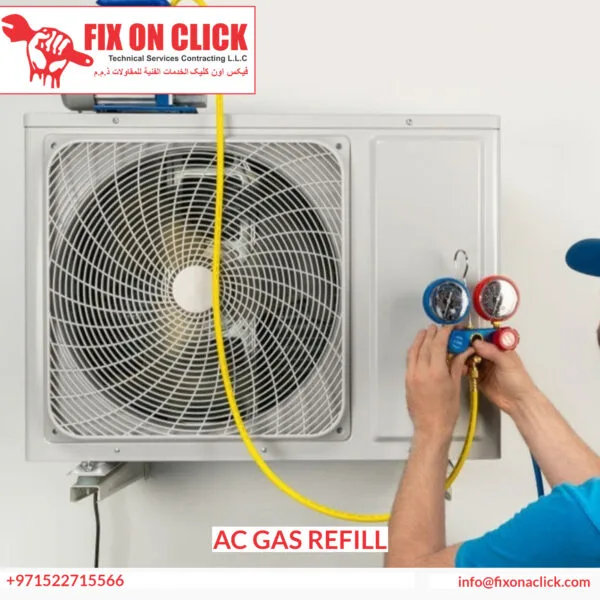
When your AC runs continuously but the room never cools down, low refrigerant is one of the most common causes. Refrigerant does not get consumed like fuel — if the level is low, there is a leak somewhere in the system. Fix On A Click locates the leak, repairs it, and refills the refrigerant to the correct level for your specific AC unit. We cover all major brands across all areas of Dubai, with same-day appointments available seven days a week.
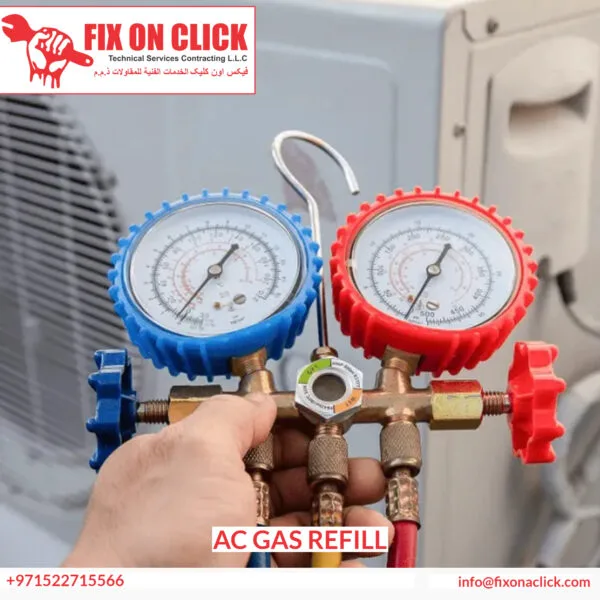
A low refrigerant AC does not just cool poorly — it forces the compressor to work harder than it should, which accelerates wear and leads to more expensive faults down the line. Addressing a refrigerant issue early is significantly cheaper than dealing with a compressor failure later. Our technicians carry R-410A and R-32 refrigerant on every vehicle and use precision manifold gauges to ensure the system is charged to the correct operating pressure for your unit.
Why Refrigerant Levels Drop — and What Happens Next
Refrigerant operates in a sealed closed-loop system. Under normal conditions, it does not reduce over time. If the level is low, a leak exists somewhere — in the coils, line connections, Schrader valves, or compressor fittings. Simply topping up without finding and fixing the source of the leak means the gas will escape again, usually within weeks or months. We see this pattern regularly when customers have had an AC refilled elsewhere without leak detection being carried out first.
In Dubai's summer months (May to September), a low-refrigerant AC running against 45°C ambient temperatures puts the compressor under severe stress. The compressor is designed to handle a certain suction pressure. When refrigerant is low, suction pressure drops well below the design range — on R-410A systems, normal suction is around 115 to 130 PSI. Low refrigerant can pull this down to 60 to 70 PSI, causing the compressor to overheat and eventually fail. Addressing a refrigerant issue early is far cheaper than replacing a compressor.
Last summer, we attended a villa in Jumeirah where the customer had topped up the gas twice in 12 months with another company. Neither visit included a leak check. The third time we attended, our technician found a hairline crack in the indoor evaporator coil. We repaired the coil, recharged the system, and the unit has run without issue since. The previous top-ups had cost more combined than the full repair.
6 Signs
Your AC Needs a Refrigerant Check
These symptoms do not always mean low refrigerant — other faults can produce similar results. But they are the most consistent indicators. If you are seeing two or more of these at once, a refrigerant check is the right first step.
AC Runs But Room Does Not Cool
The unit is operating — the fan is blowing, the outdoor unit is running — but the indoor temperature barely drops. Low refrigerant is the most common reason a properly functioning system loses cooling capacity without any obvious mechanical fault. Normal R-410A suction pressure is 115 to 130 PSI. Readings below 70 PSI typically indicate a significant refrigerant deficit.
Ice or Frost on the Indoor Unit
Low refrigerant causes the evaporator coil to run colder than it should. Moisture from the air freezes onto the coil surface. At first it looks like a light frost near the coil. As it builds up, it blocks airflow almost completely and the indoor unit starts blowing barely any air. If you see ice on the indoor unit or on the refrigerant pipe running to the outdoor unit, switch the AC off and call us.
DEWA Bill Climbing Without Explanation
A low-refrigerant AC runs far longer per cooling cycle to achieve the same indoor temperature. A 1.5-ton split unit that normally runs 8 hours a day to cool a room may run 12 to 14 hours when refrigerant is low. That extended run time adds directly to your DEWA bill. If consumption has increased by 20 to 30% without any change in usage patterns, a refrigerant check is worth doing.
Hissing or Bubbling Sounds
A hissing sound from the indoor unit, the outdoor unit, or the refrigerant lines running between them usually indicates refrigerant escaping through a crack, a loose fitting, or a failed Schrader valve. A bubbling or gurgling sound can indicate refrigerant vapour and liquid mixing where only one phase should be present. Both sounds warrant a leak check before any refill is done.
Oily Residue Around Pipe Connections
Refrigerant circulates with compressor oil. When refrigerant leaks, oil escapes with it and leaves a visible oily or slightly greasy residue at the point of escape. Check the flare connections at the indoor unit, the service ports on the outdoor unit, and along the insulated pipe run between the two. A greasy or discoloured patch at any connection point is a reliable indicator of an active leak location.
Excess Water Dripping from Indoor Unit
When the evaporator coil ices over due to low refrigerant and then the AC is switched off or cycles off, the ice thaws. The volume of water produced can exceed what the drain pan and drain line can handle. Water drips from the unit, runs down the wall, or accumulates on the floor. This is often mistaken for a drainage fault — but if refrigerant is low, fixing the drain line alone does not resolve the problem.
How We Carry Out an AC Gas Refill
An AC gas refill done properly is not a quick top-up with a can of refrigerant. It is a structured process that starts with finding and fixing the leak source, prepares the system correctly before any gas goes in, and ends with pressure and performance verification. Every step matters. Skipping any of them — particularly the leak check and system evacuation — produces a result that fails again within weeks.
Leak Detection
We connect manifold gauges to the system's service ports and check suction and discharge pressures. If readings confirm low refrigerant, we use an electronic leak detector and UV dye to locate the exact point of escape — coil surface, flare connections, service ports, or compressor fittings. We do not skip this step.
Leak Repair
The leak source is repaired before any refrigerant goes in. Depending on the location, this may involve tightening and re-flaring a connection, replacing a Schrader valve core, patching a minor coil surface defect, or replacing a section of pipe. A coil with significant corrosion or structural damage requires replacement rather than patching.
System Evacuation
Before charging, we evacuate the system with a vacuum pump to remove air and moisture from the refrigerant lines. Moisture inside a refrigerant circuit causes acid formation over time, which corrodes internal components including the compressor. Proper evacuation takes 20 to 30 minutes and is not a step that should be skipped to save time.
Precision Refrigerant Charge
We introduce the correct refrigerant type and quantity for your specific AC unit. For most residential split units, the manufacturer specifies a charge weight in grams (typically 600g to 1.4kg depending on capacity). We charge by weight using a calibrated digital scale and verify against target suction pressure — not by feel or guesswork.
Performance Verification
With the system running under load, we verify suction and discharge pressures are within the correct range for the ambient temperature and refrigerant type. We also measure supply air temperature at the indoor vents. A properly charged R-410A split unit should deliver supply air 10 to 14°C below return air temperature. Anything significantly outside that range indicates a remaining issue.
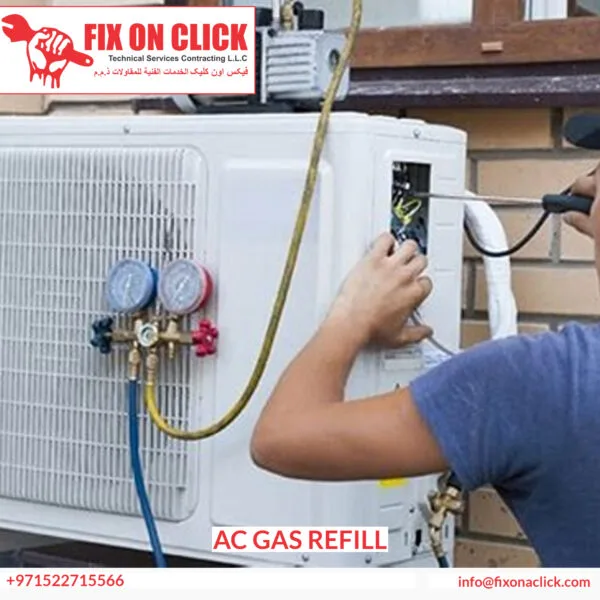
AC Gas Refill
Pricing in Dubai
Indicative pricing for common refrigerant services. Final cost is confirmed by our technician after on-site assessment of the system, refrigerant type, leak condition, and quantity required.
Gas Topping
Minor top-up, minor pressure loss
- Pressure check included
- Small quantity top-up
- R-410A or R-32
- Performance verified
Full Gas Refill
Complete recharge after leak repair
- Leak detection included
- System evacuation
- Full charge by weight
- Pressure & temp verified
Leak Repair + Refill
Leak fixed, system recharged
- Electronic leak detection
- Connection / valve repair
- Evacuation + full recharge
- Full system test
6 Solid Reasons
To Choose Fix On A Click
Here is what makes the difference between a refrigerant job that holds and one that needs repeating in six weeks.
Leak Check Before Every Refill
We never add refrigerant without first confirming where the gas is going. A top-up without a leak check is a temporary fix that fails again. We find the source, repair it, then refill — so the result lasts.
Charged by Weight, Not Guesswork
We charge refrigerant by weight using a calibrated digital scale and verify against manufacturer-specified suction pressure. This is the only accurate method. Charging by "feel" or time produces over-charged or under-charged systems that perform poorly and wear the compressor faster.
System Evacuated Before Charging
Air and moisture are removed from the refrigerant circuit via vacuum pump before any refrigerant goes in. This takes 20 to 30 minutes and prevents moisture-induced acid formation inside the system — a common cause of long-term compressor damage when this step is skipped.
Transparent Pricing Before Work Starts
You receive a clear cost covering leak detection, repairs, evacuation, refrigerant, and labour before any work begins. The price does not change after the job. What is agreed is what appears on the invoice.
All Refrigerant Types Stocked
Our technicians carry R-410A, R-32, and R-22 on every vehicle. We cover modern and older systems without needing to source refrigerant separately. Same-day service is available across Dubai seven days a week.
Performance Verified on Completion
After every refill, we run the system under load and measure suction pressure, discharge pressure, and supply air temperature. A correctly charged R-410A unit delivers supply air 10 to 14°C below return air. We confirm this before leaving.
Frequently Asked
Questions About AC Gas Refill in Dubai
Honest answers to the questions Dubai homeowners ask most about AC refrigerant and gas refill services.
How much does AC gas refill cost in Dubai?
A refrigerant top-up starts from AED 150. A full recharge including system evacuation starts from AED 300. If leak repair work is required alongside the refill, pricing starts from AED 450 depending on the leak location and repair complexity. All prices are indicative — the exact cost is confirmed by the technician after on-site assessment of the unit, refrigerant type, quantity needed, and any repair work required. Call or WhatsApp us your unit details and we will advise on likely cost before scheduling a visit.
Why does my AC keep losing gas every year?
Because there is a leak that has not been found and repaired. Refrigerant does not get consumed — if it is reducing, it is escaping somewhere. Common sources are flare connections that have loosened over time, a Schrader valve core that has deteriorated, hairline cracks in the evaporator or condenser coil, or damaged insulation causing copper pipe corrosion. If your AC needs a refill every 6 to 12 months, the leak needs to be identified and fixed. Repeated top-ups without finding the source is an expensive cycle that does not resolve the underlying fault.
What refrigerant does my AC use?
The refrigerant type is printed on a label on the outdoor unit, usually near the service ports. Most AC units installed in Dubai in the last 10 to 12 years use either R-410A or R-32. R-410A is the most common in units installed before 2019. R-32 is used in many newer, higher-efficiency models from brands like Daikin, Mitsubishi, and Panasonic. Older systems (typically pre-2010) may use R-22, which is now being phased out. You must never mix refrigerant types — a system designed for R-410A cannot be topped up with R-22 or R-32. Our technicians identify the correct refrigerant before any charging work is done.
Can I add refrigerant to my AC myself?
No. Handling refrigerant requires certified training, proper equipment, and an understanding of pressures that are dangerous if mishandled. R-410A operates at much higher pressures than older refrigerants — discharge pressures can reach 400 PSI or above. Incorrect charging (over or under) damages the compressor. Refrigerant that contacts skin or eyes causes severe frostbite-like injury. In the UAE, handling refrigerant without certification is also a regulatory violation. Leave this work to a qualified technician.
How long does an AC gas refill take?
A complete job — pressure check, leak detection, leak repair, system evacuation, refrigerant charge, and performance verification — typically takes 1.5 to 2.5 hours for a standard residential split unit. The evacuation step alone takes 20 to 30 minutes and cannot be rushed. If coil repair or pipe repair is required, the total time may extend to 3 to 4 hours depending on the complexity of the repair. We give you a time estimate after the initial diagnosis so you can plan accordingly.
Is low refrigerant bad for the compressor?
Yes, significantly. The compressor relies on refrigerant returning from the evaporator to cool its motor windings. When refrigerant is low, the suction gas returning to the compressor is warmer and at lower pressure than the design requires. The compressor runs hotter, works harder, and wears faster. In Dubai's peak summer, an AC running with low refrigerant against 45°C ambient temperature puts the compressor under far greater stress than it was engineered for. Compressor failure following a prolonged low-refrigerant condition is one of the most common repair scenarios we attend during July and August.
My AC was just serviced and cleaned — could it still need a gas refill?
Yes. A standard AC service — filter cleaning, coil washing, drain clearing — does not include refrigerant pressure checking or leak detection. These are separate diagnostic steps. Many service visits in Dubai do not check refrigerant levels at all unless it is specifically requested or the technician notices symptoms during the service. If your AC was recently serviced but is still not cooling well, a refrigerant check is a sensible next step. Bring it up with us when you call and we will advise on the right approach.
How do I book an AC gas refill in Dubai?
Call or WhatsApp Fix On A Click on +971 52 271 5566. Let us know the AC brand and model if you have it, describe the symptoms you are seeing (not cooling, ice on unit, hissing sound, rising bills), and tell us your location in Dubai. We schedule a technician visit at a convenient time — same-day appointments are usually available. We cover every area of Dubai and respond to calls and messages seven days a week.
Book Your AC Gas Refill Today
If your AC is running but not cooling, showing ice on the coil, producing hissing sounds, or your DEWA bill has climbed without explanation — call or WhatsApp us. We schedule a technician visit at a time that suits you, carry out a proper leak check before adding any refrigerant, and confirm the cost before starting any work. Same-day appointments are available across all areas of Dubai seven days a week.
We serve Downtown Dubai, Dubai Marina, JBR, Palm Jumeirah, JVC, Al Barsha, Business Bay, Jumeirah, DIFC, Mirdif, Deira, Bur Dubai, Arabian Ranches, Al Quoz, Dubai Hills, Silicon Oasis, and all surrounding communities.
AC Gas Refill Across All of Dubai
Don't see your area? We cover every corner of Dubai — call us and we will come to you.