Professional VRF System Installation Services in Dubai
Variable Refrigerant Flow systems represent a fundamentally different approach to climate control — one that delivers only the refrigerant each zone actually needs, at the moment it needs it. For commercial buildings, mixed-use developments, hotels, offices, and large residential properties in Dubai, VRF technology removes the compromise between comfort and energy consumption that older HVAC systems force on building operators. Fix On Click carries out VRF system installation across all areas of Dubai, from single-zone commercial fit-outs to full multi-building deployments with BAS integration.
Dubai's climate demands are among the most extreme in the world. Systems run close to full capacity for six months or more each year, and buildings with diverse occupancy patterns — different zones used at different times for different purposes — expose the inefficiency of fixed-capacity conventional systems very quickly. A VRF installation designed and commissioned correctly responds to these demands in real time, running only the capacity each zone requires at each moment, and recovering heat between zones where possible. The result is measurable: lower running costs, more consistent indoor temperatures, and significantly less wear on the equipment itself.


How VRF Technology Actually Works
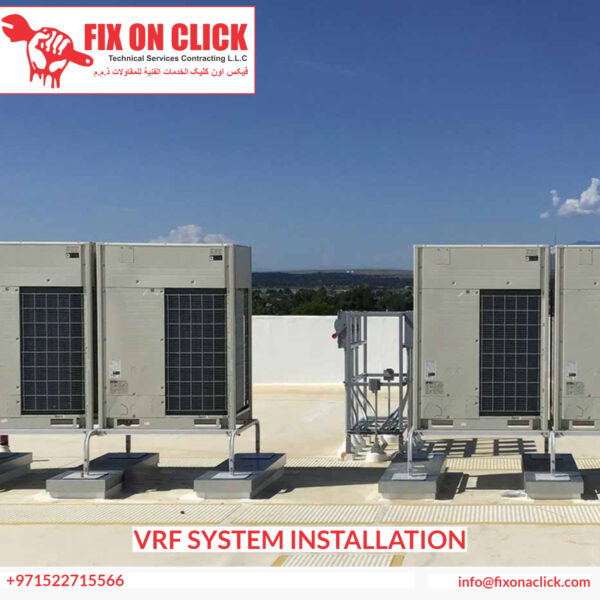
A VRF system connects a single outdoor condensing unit — or a set of linked outdoor units for larger installations — to multiple indoor fan coil units distributed across different zones of a building. The outdoor unit houses an inverter-driven compressor that can modulate its speed continuously, rather than simply switching between on and off as conventional systems do. This variable speed operation is what gives the technology its name and its efficiency advantage.
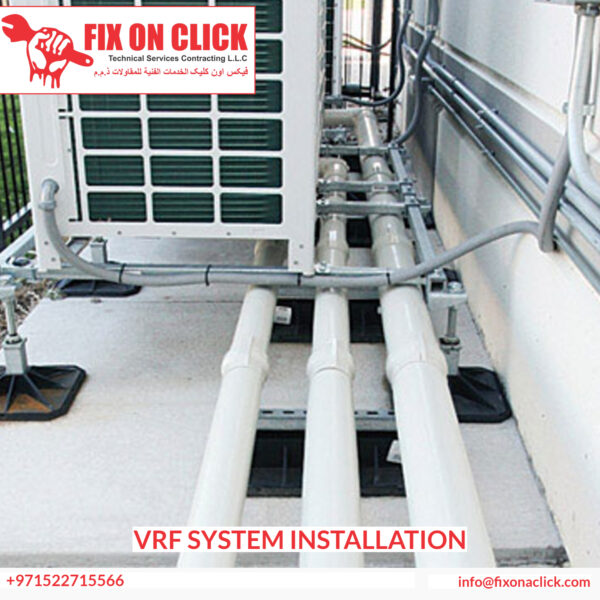
Refrigerant is distributed from the outdoor unit to each indoor unit through a branched piping network. Electronic expansion valves at each indoor unit regulate the precise amount of refrigerant delivered to that zone based on real-time demand. When a meeting room is empty, the valve to that zone throttles down. When the server room needs continuous cooling while the adjacent office only needs light cooling, each zone receives exactly what it requires, simultaneously and independently. Heat recovery VRF configurations take this further: heat extracted from zones being cooled can be redirected to zones that need heating at the same time, which in Dubai's shoulder seasons produces dramatic efficiency gains.
The practical outcome is a system that adapts continuously to building load rather than forcing the building to adapt to the system's fixed output. For Dubai's long cooling season and variable occupancy patterns, this makes a measurable difference to both comfort and running costs.
Why VRF
Outperforms Conventional HVAC in Dubai
Compared to traditional chiller plants, split systems, or fan coil units on a fixed chilled water loop, VRF systems deliver measurable advantages that matter specifically in Dubai's operating conditions.
Significant Energy Reduction
VRF systems run at partial load the majority of the time, matching output to actual demand rather than cycling between full-on and full-off. In Dubai's climate where systems run for extended periods, this partial-load efficiency advantage compounds significantly across a full year of operation, with clients regularly reporting energy reductions of 25 to 40% against the systems they replaced.
Independent Zone Control
Every indoor unit operates independently. A boardroom running at full capacity, a vacant corridor set to minimum, and a server room needing constant cooling can all coexist on the same system simultaneously without any zone affecting another. For commercial properties and hotels, this removes the compromise of centralised systems that over-cool unoccupied spaces to maintain comfort in occupied ones.
Heat Recovery Between Zones
Heat recovery VRF configurations extract heat from zones being cooled and deliver it to zones that need heating. In Dubai's shoulder months — October through April — when sun-facing zones need cooling while shaded or north-facing areas need mild heating, this heat transfer happens within the refrigerant circuit rather than requiring separate heating systems, producing the most efficient operating mode the system can achieve.
Low Noise Operation
The compressor runs at variable speed and is located outdoors. Indoor units operate at low fan speeds for the majority of running time because the system maintains set temperatures through refrigerant modulation rather than air volume. The result is significantly quieter indoor environments compared to fan coil systems running at high capacity, which matters in hotel rooms, offices, and high-end residences.
Flexible Piping Configuration
VRF refrigerant pipework can run considerably longer distances between outdoor and indoor units compared to direct expansion split systems. This makes VRF practical for tall buildings, buildings with remote plant rooms, and properties where the outdoor unit location is constrained. Multiple outdoor units can also be linked to create higher capacity systems for large buildings without requiring a central plant room.
Smart Controls and BAS Integration
Modern VRF systems connect to building automation systems, allowing facility managers to monitor and control every zone from a single interface. Occupancy-linked scheduling, demand response integration, and remote access via mobile app reduce energy waste from systems running in unoccupied spaces — one of the most common sources of unnecessary HVAC energy consumption in commercial buildings.
Reduced Mechanical Room Requirement
Unlike chiller-based systems that require dedicated plant rooms with chillers, cooling towers, and pump sets, VRF systems distribute the mechanical equipment across the building in compact outdoor units and ceiling-concealed or wall-mounted indoor units. This releases plant room space for productive use and simplifies the overall mechanical infrastructure of the building.
Scalability for Phased Projects
VRF systems can be installed in phases. An outdoor unit can initially serve a partial indoor unit complement, with additional indoor units added as a building is occupied or expanded. This avoids the cost of installing full cooling infrastructure for spaces that are not yet in use, and allows capital expenditure to track actual occupancy rather than being committed upfront for theoretical future capacity.
Our Approach to VRF System Installation
VRF installation is not a field where shortcuts produce acceptable outcomes. An incorrectly charged refrigerant circuit, piping runs that exceed the manufacturer's specified equivalent length, or pressure imbalances across a complex branching network will degrade system performance from day one — and in ways that are not always immediately obvious. Efficiency losses, inconsistent zone temperatures, and compressor wear that appears years early are the typical consequences of an installation that was rushed or under-engineered. Every VRF installation Fix On Click undertakes begins with a site assessment that gathers the specific data the system design requires.
Detailed Site Survey and Load Calculation
We assess the full building envelope: floor area per zone, insulation specification, glazing type and orientation, occupancy schedules, equipment heat loads, and the location constraints for outdoor unit placement. Load calculations are carried out zone by zone, not estimated from floor area alone. This data determines the system capacity, indoor unit selection, and piping configuration.
Refrigerant Piping Design and Routing
Refrigerant piping in a VRF system must stay within the manufacturer's specified total equivalent pipe length and height differential between the outdoor unit and the furthest indoor unit. We design the piping layout to respect these limits while minimising material runs, avoiding conflict with structural elements, and ensuring access for future maintenance. Every branch box location and pipe diameter is specified before installation begins.
Pressure Testing and Vacuum Procedure
Before any refrigerant is introduced, the completed piping circuit is nitrogen pressure-tested to confirm there are no leaks at any brazed joint or connection point. The circuit is then evacuated to a deep vacuum and held for the time specified by the manufacturer. Only a circuit that holds vacuum is charged with refrigerant. These steps are not optional — a refrigerant leak inside a completed ceiling void is extremely difficult and expensive to locate and repair.
Commissioning and Controls Configuration
System commissioning includes verifying the refrigerant charge against the calculated additional charge for the actual pipe length installed, configuring the communication wiring between all indoor and outdoor units, setting up zone groups and schedules in the central controller, and running the system through all operating modes to confirm every indoor unit is responding correctly. Smart control integration and BAS connection are completed and tested during commissioning.
Handover and Operator Training
At handover, we walk through the system controls with the building operator or facility manager. Schedules, zone groupings, temperature limits, and fault alert settings are configured to match the building's operational requirements. Operating and maintenance documentation for the specific system installed is provided, along with a commissioning report confirming what was tested and the results.
How It Works
Our VRF Installation Process
Every VRF installation follows a structured sequence from initial survey through to post-commissioning handover. The process does not vary based on project size — a smaller installation receives the same design rigour as a large commercial deployment.
Initial Consultation
Site Survey & Load Calc
System Design & Quotation
Installation
Commissioning & Handover
VRF Installation Pricing
VRF system installation pricing is determined by the system capacity, number of indoor units, pipe run length, building access conditions, and controls specification. Every project receives an itemised quotation after site survey.
VRF System Installation
Final cost will be confirmed after on-site inspection. Prices listed are indicative and may vary depending on system capacity, number of indoor units, pipe run lengths, building access conditions, controls specification, and parts required. For detailed pricing, please contact our HVAC technician directly.
Why Dubai Properties
Trust Fix On Click for VRF
VRF installation is one of the more technically demanding HVAC services. The system's performance — its efficiency, its zone control accuracy, its long-term reliability — is almost entirely determined by the quality of the design and the commissioning, not just the equipment itself. Two properties with identical VRF equipment from the same manufacturer can perform very differently depending on how the systems were sized, how the pipework was laid, and whether the refrigerant charge was calculated and verified correctly at commissioning. These are not details that correct themselves over time.
Fix On Click technicians are trained on the major VRF platforms used in the UAE market. We carry out the refrigerant piping work, the electrical and communication wiring, the nitrogen pressure testing, the vacuum procedure, and the commissioning as a single continuous process — not as separate subcontract elements handed between different teams. This continuity of responsibility is significant in a system type where a mistake in one phase is often not visible until the next phase reveals it.
We work across commercial offices, retail fit-outs, hotel rooms and back-of-house areas, residential villas, educational facilities, and mixed-use developments throughout Dubai. The system types we install include cooling-only VRF, heat pump VRF for shoulder-season heating capability, and heat recovery VRF for buildings with simultaneous cooling and heating demands across different zones. Every project begins with a site survey and ends with a commissioning report. We do not skip either end of that process.
10+ Years Active
Trained Technicians
All Dubai Areas
7 Days a Week
Commissioning Reports
6 Solid Reasons To Choose Fix On Click
Building owners and facilities managers across Dubai choose Fix On Click for VRF installation based on how the work is carried out from survey to commissioning report.
Zone-by-Zone Load Calculations
System sizing is calculated from measured zone data, not estimated from floor area. Correctly sized indoor units maintain set temperatures at the lowest possible running cost. Oversized units short-cycle and fail to dehumidify properly. Undersized units cannot meet the load. We size from data.
Nitrogen Testing on Every Job
Every completed piping circuit is nitrogen pressure-tested before vacuum and charge. A refrigerant leak inside a finished ceiling void is one of the most expensive and disruptive HVAC faults to rectify. Testing the circuit before refrigerant is introduced eliminates that risk entirely.
Full Commissioning, Not Just Connection
Commissioning covers refrigerant charge verification, all operating modes on every indoor unit, controls and schedule configuration, and BAS integration testing. A connected system is not a commissioned system. We complete both before handover.
Commissioning Report Provided
Every installation is documented with a commissioning report that records what was tested, the results, and the system settings at handover. This is the reference document for future maintenance and troubleshooting, and confirms what was done by the installing team.
Commercial and Residential Both Covered
We work across offices, retail, hotels, educational facilities, and large residential properties. Commercial VRF projects often require phased installation to allow continued building operation. We plan and coordinate around your occupancy requirements.
All Dubai Areas, One Point of Contact
One number covers all of Dubai. Downtown, Business Bay, DIFC, Dubai Marina, JLT, Al Barsha, Al Quoz, Media City, Silicon Oasis, Mirdif, Deira, and every industrial and commercial development across the emirate. No area surcharges.
Other HVAC Services
We Provide Across Dubai
Fix On Click covers the full range of residential and commercial HVAC services. One contact handles everything your cooling and ventilation systems require.
AC Installation
Split unit, cassette, and ducted system installation for residential and commercial properties across all brands.
AC Maintenance
Scheduled servicing to maintain efficiency, extend equipment life, and prevent faults before they develop into failures.
AC Repair
Fault diagnosis and repair covering refrigerant issues, electrical faults, fan failures, and control board problems across all system types.
AC Duct Cleaning
HEPA extraction duct cleaning for ducted systems including the full duct network, AHU coil, and supply grilles.
Frequently Asked
Questions About VRF System Installation
Direct answers to what Dubai building owners, developers, and facilities managers ask most about VRF system installation.
What is a VRF system and how is it different from a standard split AC?
A standard split AC system has one outdoor unit connected to one indoor unit. The compressor operates at fixed speed and cycles between full-on and full-off to maintain temperature. A VRF system connects one outdoor unit to multiple indoor units across different zones. The compressor runs at variable speed, adjusting continuously to match the combined real-time demand from all connected indoor units. Each indoor unit receives exactly the refrigerant it needs at that moment. The result is simultaneous independent control of multiple zones from a single outdoor unit, with significantly better part-load efficiency than a collection of individual split systems.
What is the difference between heat pump and heat recovery VRF?
A heat pump VRF system can switch between cooling mode and heating mode, but all indoor units must operate in the same mode at the same time — all cooling or all heating. A heat recovery VRF system can simultaneously cool some zones while heating others. Heat extracted from the cooling zones is transferred within the refrigerant circuit to the zones needing heat, rather than being rejected outdoors. For buildings in Dubai's shoulder seasons where sun-exposed zones need cooling while shaded zones need mild heating, heat recovery VRF is significantly more efficient than heat pump VRF. For buildings that only need cooling throughout the year, cooling-only VRF is the simplest and most cost-effective option.
How many indoor units can connect to one VRF outdoor unit?
This varies by manufacturer and outdoor unit capacity, but a single outdoor unit can typically serve between 8 and 64 indoor units depending on the system range and the capacity of each connected indoor unit. There are also limits on the total connected indoor unit capacity as a percentage of outdoor unit capacity — generally between 50% and 130% depending on the manufacturer's specification for that system. For larger buildings, multiple outdoor units can be linked to create a combined system with higher capacity and more indoor unit connections. The specific limits applicable to any project are determined during the design phase.
Is VRF suitable for a villa as well as commercial buildings?
Yes. While VRF is most commonly specified for commercial buildings, it is also well suited to larger residential villas with multiple rooms where individual zone control and a single outdoor unit are both priorities. Dubai villas with five or more rooms, multiple floors, and requirements for quiet indoor operation are good candidates for VRF. The economics of VRF versus multiple split systems depend on the total connected indoor unit count and the value placed on consolidated outdoor equipment, reduced electrical infrastructure, and individual zone control. We assess both options during consultation and provide a comparison where it is useful.
How long does VRF installation take?
Installation duration depends on the number of indoor units, the complexity of the piping layout, the building access conditions, and whether installation needs to be phased around building occupation. A small commercial fit-out with 10 to 15 indoor units in an accessible, unfinished space can typically be installed in 3 to 5 working days. Larger systems in occupied buildings where work must be phased around operational hours take considerably longer. We provide a project timeline as part of the quotation once the site survey and system design are complete.
Can VRF systems connect to a building automation system?
Yes. All major VRF systems used in Dubai support BAS integration via open protocols including BACnet and Modbus. This allows the VRF system to be monitored and controlled from a central building management system alongside other building services. For buildings with complex occupancy schedules, energy management requirements, or multiple tenants with separate billing needs, BAS integration is a significant operational advantage. We configure and test the BAS integration point as part of the commissioning process on projects where it is specified.
What maintenance does a VRF system require?
VRF systems require periodic maintenance covering filter cleaning at each indoor unit, coil inspection and cleaning on both indoor and outdoor units, refrigerant circuit pressure checks, electrical connection inspection, condensate drain clearing, and controls diagnostics. The outdoor unit coil in Dubai's dusty environment accumulates fouling significantly faster than manufacturers' schedules assume, which is based on typical ambient conditions in temperate climates. We recommend annual maintenance at a minimum for Dubai installations, with additional coil checks during or after dust season. We provide maintenance schedules with every installation.
How do I arrange a VRF installation consultation in Dubai?
Call or WhatsApp Fix On Click on +971 52 271 5566. Tell us the property type, total floor area, number of zones or rooms requiring independent control, and whether you have an existing HVAC system or this is a new installation. We schedule a site survey at a time that suits you and use the survey data to produce a system design and itemised quotation. We cover every area of Dubai and can typically schedule a site survey within 48 to 72 hours of first contact.

Book Your VRF Consultation Today
If you are planning a VRF system for a new build, a fit-out, or a replacement of an existing HVAC system, call or WhatsApp Fix On Click. Tell us the property type, the floor area, and the number of zones you need independently controlled. We schedule a site survey, produce a system design and itemised quotation, and guide the project through to commissioning and handover.
We serve commercial offices, retail spaces, hotels, educational facilities, and residential villas across Downtown Dubai, Business Bay, DIFC, Dubai Marina, JLT, Al Barsha, Al Quoz, Media City, Silicon Oasis, Mirdif, Deira, Bur Dubai, and every other area and development across the emirate.
VRF System Installation Across All of Dubai
Don't see your area? We cover every corner of Dubai — call us and we will come to you.