
Air Conditioner Repair Near Tilal Al Ghaf Dubai: What Every Resident Should Know
Looking for air conditioner repair near Tilal Al Ghaf Dubai? Whether your AC just stopped cooling or you want to avoid that call at 2am in August — here’s practical advice from technicians who’ve worked in this area for years. If you need AC repair near me in Tilal Al Ghaf or nearby communities like Dubai Sports City, this guide covers everything you need to know.
Tilal Al Ghaf is one of the newer master-planned communities in Dubai, and if you’ve moved in recently, you’re probably still figuring out how everything works — including your AC system. The units installed in these developments are generally newer and more efficient, but that doesn’t make them immune to Dubai’s climate. If anything, residents here tend to be caught off guard when something goes wrong, because the assumption is that new means problem-free.
It doesn’t. Not in Dubai, anyway.
The heat here operates on a different level than what most AC systems are designed and tested for. Your unit wasn’t built with 47-degree summers in mind. It was certified for conditions that Dubai routinely exceeds, and it runs nearly around the clock from May through October. That’s the reality — and understanding it changes how you think about AC maintenance and repair entirely.
This post covers what you actually need to know: the problems most likely to affect your system, the difference between things you can manage yourself and things that need a professional, and what to do when the AC gives up in the middle of a Dubai summer. Whether you’re in the middle of a crisis right now or just being smart about preventing one, there’s something useful here for you.
Why AC Systems Struggle in Tilal Al Ghaf and Nearby Areas
Most AC manufacturers design their equipment to handle ambient temperatures up to around 46°C. Dubai regularly crosses that line, and when outdoor temperatures exceed the unit’s rated operating range, the system has to work significantly harder to do the same job. Imagine driving your car with the handbrake partially on — the engine is working, but it’s burning through more fuel and wearing out faster than it should.
Now imagine doing that every single day for six months straight.
That’s what your AC compressor is dealing with every summer. The compressor is the heart of the system — it’s what actually drives the cooling cycle — and it’s under the most stress when outdoor temperatures are at their worst. Pair that with Dubai’s dust, humidity spikes at night, and hard water in some cooling systems, and you’ve got a unit that ages faster than it would almost anywhere else in the world.
Newer communities like Tilal Al Ghaf have an added layer to consider: the construction dust. Even well after handover, fine particles from nearby ongoing construction work their way into filters and coils faster than in fully established neighborhoods. Residents in villas and townhouses here often need to clean or replace their filters more frequently than the manufacturer’s schedule suggests — sometimes every two weeks during heavy construction phases nearby.
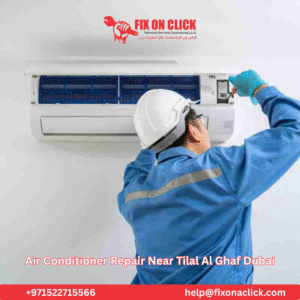
Fix on Click’s 60+ Vehicle Fleet: Always Nearby When You Need Us
When your AC breaks down at 45°C in Tilal Al Ghaf, waiting hours for a technician isn’t an option. That’s why Fix on Click operates a fleet of 60+ fully equipped service vehicles across Dubai — and our coverage is specifically designed to reach every community quickly.
Our Fleet & Coverage:
- 60+ Service Vehicles — Fully stocked with common AC parts, refrigerants, and diagnostic tools. No waiting for parts to arrive.
- Dedicated Tilal Al Ghaf Coverage — Our technicians are permanently assigned to the Tilal Al Ghaf area, meaning we can reach any location — from the villas near the lagoon to the townhouses near the retail district — within minutes, not hours.
- Dubai Sports City Team Always Ready — Just like Tilal Al Ghaf, our Dubai Sports City team is available anytime with dedicated vehicles in that area. Whether you’re in Canal Residence, Victory Heights, or Olympic Park, our Sports City technicians are never far away.
- Same-Day Emergency Response — Because our fleet is already positioned across Dubai including Tilal Al Ghaf and Dubai Sports City, we offer genuine same-day service for urgent AC breakdowns. Most calls are attended within 30-60 minutes.
- Familiar with Your Building’s Systems — Our team knows the specific AC systems installed in Tilal Al Ghaf developments. Whether it’s a Daikin split unit or a central cooling system, we’ve worked on it before.
- Available 7 Days a Week — Our 60+ vehicle fleet operates across Dubai every day. For Tilal Al Ghaf and Dubai Sports City residents, this means whether it’s a Tuesday afternoon or a Friday night emergency, a Fix on Click technician is never far away.
Why Our Fleet Matters: Most AC repair companies in Dubai have 5-10 vehicles for the entire city. Fix on Click’s 60+ vehicle fleet means when you call from Tilal Al Ghaf, you’re not competing with someone in Deira or JLT for the same technician. Our dedicated team is already in your area.
Problems That Come Up Most Often in Tilal Al Ghaf
After working on AC systems across Dubai for years, certain problems show up repeatedly. They’re not unique to Tilal Al Ghaf, but they’re the ones most likely affecting your unit right now — or will be soon if left unchecked.
The Unit Runs but the Room Stays Warm
This is the number one complaint. The AC is on, you can hear it, air is blowing — but the temperature isn’t dropping. The first thing to check is your filter. A filter clogged with dust restricts airflow so severely that the system essentially can’t transfer heat efficiently. What should be cold air becomes barely-cool air because the evaporator coil is smothered.
If the filter is clean and the problem persists, the likely culprits are low refrigerant or dirty evaporator coils. Refrigerant doesn’t evaporate or get consumed — if levels are low, there’s a leak somewhere in the system. A technician needs to find it, seal it, and recharge the refrigerant properly. Topping it up without fixing the leak is a temporary patch that wastes money and damages the compressor over time.
Water Dripping Inside Your Home
Water stains on walls, dripping from the indoor unit, pooling on the floor — all signs of a drainage problem. The AC pulls moisture out of the air as it cools, and that water has to go somewhere. It flows through a drain line that, in Dubai’s conditions, gets blocked by algae, mold, and dust buildup surprisingly quickly.
A blocked drain isn’t just inconvenient — leave it long enough and water backs up into the drain pan, overflows, and starts damaging walls, ceilings, and flooring. In Tilal Al Ghaf’s newer properties with premium finishes, that damage is expensive to fix. Clearing the drain line is a straightforward job for a technician and takes maybe 20 minutes. Repairing water-damaged gypsum and repainting is a different conversation entirely.
Short Cycling — the Problem Most People Don’t Recognize
If your AC turns on, runs for three or four minutes, shuts off, then starts again five minutes later — that’s called short cycling, and most people don’t realize it’s a problem because the unit is technically “working.” But the compressor is being hammered every time it starts under full load. Starting is the most stressful moment for a compressor, and doing it dozens of times a day instead of a handful destroys it prematurely.
Short cycling has several possible causes: an oversized unit for the space, low refrigerant, a failing capacitor, or the system overheating and tripping its thermal protection. Each needs a different fix, but all of them need professional diagnosis — this isn’t something you can resolve by adjusting the thermostat.
Capacitor Failure
The start capacitor is a small component that gives the compressor and fan motors the extra jolt of power they need to start up. It’s also one of the most common failure points in Dubai, specifically because capacitors degrade faster at high temperatures. A failing capacitor usually announces itself with clicking sounds when the unit tries to start, or the unit will hum but the fan won’t spin. Complete failure means the unit simply doesn’t start at all.
The good news: capacitor replacement is one of the quicker and more affordable repairs. The bad news: if it fails completely during peak summer and you’re not getting same-day service, you’re in for an uncomfortable wait.
Compressor Issues
The compressor is the most expensive component in your AC system. It can fail from running continuously at extreme temperatures, from refrigerant leaks that weren’t caught early, from short cycling stress, or simply from age accelerated by Dubai conditions. When it goes, you usually know — the unit either doesn’t cool at all, makes loud grinding or rattling sounds, or trips the circuit breaker repeatedly.
A compressor replacement is a significant repair, but it’s often still worth doing on a relatively new unit versus full replacement. This is a conversation worth having with whoever is diagnosing the problem — a straightforward yes or no on whether repair or replacement makes more financial sense given the unit’s age and condition.
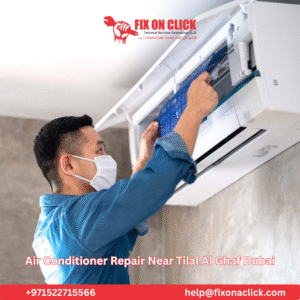
What You Can Actually Handle Yourself
There’s a practical boundary between homeowner maintenance and professional repair work, and it’s worth being clear about where that line sits.
Cleaning your filter is the single most impactful thing you can do for your AC’s performance and longevity. For split units, this usually means pulling out the filter panel on the indoor unit, removing the mesh filter, rinsing it under running water, letting it dry completely, and putting it back. In Dubai, this should happen every two to three weeks during heavy use — not monthly, and definitely not “when you remember.”
Beyond the filter, keep the area around the outdoor condenser unit clear. It needs airflow to dump the heat it pulls from your home. If the condenser is surrounded by plants, stored items, or built-up debris, it can’t work efficiently. A quick check and clearance every few months is all it takes.
Check your drain line periodically if you know where it exits. A small trickle of water is normal. No dripping at all on a running system might mean the drain line is blocked before it even reaches the exit point. Water stains near the indoor unit are the more obvious signal.
Everything beyond that — anything involving refrigerant, electrical components, internal coil cleaning, or diagnosing why the unit isn’t performing correctly — belongs to a technician. Not because it’s overly complicated, but because refrigerant handling requires certified equipment, electrical components in an AC that’s been running in Dubai summers can hold dangerous charges, and misdiagnosis leads to throwing parts and money at a problem without actually fixing it.
AC Repair Costs in Tilal Al Ghaf
One of the first questions Tilal Al Ghaf residents ask when calling for air conditioner repair near Tilal Al Ghaf Dubai is about cost. Here’s what you can typically expect:
| Service Type | Estimated Cost (AED) |
|---|---|
| General AC Service & Cleaning | 149 – 250 |
| Filter Cleaning Only | 50 – 100 |
| Capacitor Replacement | 150 – 300 |
| Refrigerant Leak Detection & Repair | 400 – 800 |
| Compressor Replacement | 1,500 – 2,500 |
| Emergency Call-Out (After Hours) | +100 – 200 |
| Full AC Deep Clean (Coils + Drain) | 250 – 400 |
Note: Actual AC repair costs in Tilal Al Ghaf depend on the AC brand, unit size, and extent of damage. Fix on Click provides upfront quotes before starting any work.
The Case for Preventive Maintenance in Tilal Al Ghaf
Most AC service calls are predictable. The drain line that floods a ceiling was blocked for months. The compressor that seized in August was running with low refrigerant since April. The capacitor that failed had been showing symptoms for weeks. None of these are sudden failures — they’re gradual problems that reach a breaking point.
A preventive maintenance visit before summer — ideally March or early April, before the real heat locks in — catches these things while they’re still minor. The technician cleans the coils, flushes the drain, checks refrigerant pressure, tests the capacitor and other electrical components, and gives you an honest picture of what’s in good shape and what to watch.
The difference in cost between a routine maintenance visit and an emergency compressor replacement is significant. More practically: a maintenance visit happens on a schedule you control. An emergency repair happens at 11pm on a Saturday when every technician in Dubai is already busy with someone else’s breakdown.
Fix on Click offers maintenance packages that cover exactly this — scheduled visits designed around Dubai’s seasons, not arbitrary calendar dates. For Tilal Al Ghaf residents, having a standing maintenance arrangement means your system gets looked at before the heat peaks, not after it’s already failed. You can get details on what’s included at fixonaclick.com or just call to discuss what makes sense for your setup: +971 52 271 5566.
Signs Your AC Needs Professional Attention Now
Some things can wait a few days. Others genuinely can’t. Here’s how to read the difference.
A burning or electrical smell coming from any part of the system — indoor or outdoor — means turn it off at the breaker, not just with the remote, and call someone. That smell is overheating electrical insulation or components, and running the unit risks a fire in the wiring.
Ice on the indoor unit, on the refrigerant lines, or visible anywhere on the system means shut it down and let it thaw completely before running it again. Ice forming is the system telling you something is fundamentally wrong — usually low refrigerant or severely blocked airflow. Running a frozen system damages the compressor.
If the circuit breaker trips every time the AC starts, that’s the breaker protecting your electrical system from a fault in the unit. Resetting it repeatedly without finding the cause is how breakers and wiring get damaged. Get a technician to diagnose it.
Grinding, screeching, or intermittent banging from the outdoor unit almost always means mechanical damage — fan blades, motor bearings, or compressor internals. The longer a mechanically damaged system runs, the more expensive the repair gets.
And obviously: if your AC simply isn’t cooling your home to a livable temperature during Dubai summer, that’s not a minor inconvenience to monitor. It’s a health concern. Elderly people, young children, and anyone with health conditions can be seriously affected by prolonged heat exposure indoors. Get it seen to the same day if possible.
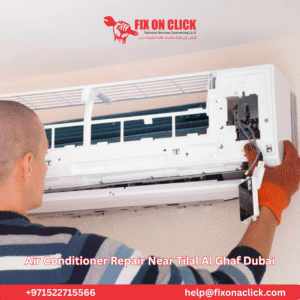
What Happens When Fix on Click Shows Up
For residents in Tilal Al Ghaf who haven’t used Fix on Click before, here’s what to expect. The technician arrives, listens to what you’ve described, and starts with a systematic check of the system rather than guessing at the problem. They’ll test refrigerant pressure, inspect the electrical components, check the drain and coil condition, and look at the outdoor unit.
After diagnosis, you get a clear explanation of what’s wrong and what it will cost to fix — before any work starts. No surprise charges at the end. If there are multiple issues, they’ll tell you which ones are urgent and which can wait, so you can make an informed decision about what to do now versus later.
For straightforward repairs — capacitor replacement, drain cleaning, refrigerant top-up after a confirmed and repaired leak, filter cleaning — most jobs are completed the same visit. For anything requiring parts that aren’t on the van, they’ll give you a realistic timeline rather than vague promises.
Same-day emergency service is available for urgent situations. If your AC has failed completely in peak summer heat, that qualifies. Reach Fix on Click at +971 52 271 5566 and explain the situation — they’ll prioritize accordingly.
A Practical Schedule for Tilal Al Ghaf Residents
If you want a simple framework for staying ahead of AC problems in this community, this is what makes sense given Dubai’s seasons and the specific conditions here:
March: Book a full service visit before summer. Coil cleaning, drain flush, refrigerant check, electrical inspection. This is the single most valuable thing you can do.
Monthly through summer (May–September): Clean your filter yourself. Takes ten minutes and has a meaningful impact on performance and efficiency.
After any sandstorm: Check the outdoor condenser unit for debris and the filter for visible clogging. Sandstorms push more particulate into the system in one event than weeks of normal operation.
October: A lighter check-up after the heavy summer workload. A good time to address anything that’s been developing over the hot months before winter brings milder conditions.
That’s it. Nothing complicated, nothing expensive if done on schedule. The expensive situations happen when these steps get skipped.
Frequently Asked Questions About AC Repair in Tilal Al Ghaf
How much does AC repair cost in Tilal Al Ghaf?
Minor repairs like capacitor replacement in Tilal Al Ghaf start around AED 150-300. Major repairs like compressor replacement can range from AED 1,500-2,500 depending on the AC brand and unit type. Fix on Click provides free upfront quotes for all AC repair work in Tilal Al Ghaf.
Why is my AC running but not cooling in my Tilal Al Ghaf apartment?
In Tilal Al Ghaf’s climate, the most common causes are dirty filters (from desert dust and construction particles), low refrigerant due to leaks, or frozen evaporator coils from overuse. Start by cleaning your filter — this resolves about 40% of “not cooling” issues in Tilal Al Ghaf.
How often should I service my AC in Tilal Al Ghaf?
Given the heavy usage, construction dust, and extreme heat in Tilal Al Ghaf, AC units should be serviced every 3-4 months, not annually like in cooler climates. Tilal Al Ghaf’s combination of extreme heat, dust, and humidity puts significantly more stress on AC systems than standard manufacturer recommendations account for.
Does Fix on Click offer same-day AC repair in Tilal Al Ghaf?
Yes, Fix on Click provides same-day emergency AC repair in Tilal Al Ghaf. With our fleet of 60+ service vehicles positioned across Dubai, most Tilal Al Ghaf calls are attended within 30-60 minutes. Call +971 52 271 5566 for immediate assistance.
What AC brands do you repair in Tilal Al Ghaf?
Fix on Click services all major AC brands commonly found in Tilal Al Ghaf homes, including Daikin, Carrier, LG, Samsung, Gree, Mitsubishi, and O General. Our Tilal Al Ghaf technicians carry common parts for these brands, minimizing wait times for repairs.
Why does my AC leak water in Tilal Al Ghaf?
Water leaking from indoor AC units is very common in Tilal Al Ghaf due to high humidity and condensation volume. The most common cause is a blocked drain line — algae and mold grow quickly in Dubai’s humid conditions. A professional AC repair technician can clear the blockage and treat the drain pan to prevent recurrence.
Is AC repair in Tilal Al Ghaf covered by warranty?
Fix on Click provides a service warranty on all AC repair work in Tilal Al Ghaf. The specific warranty period depends on the type of repair — parts replaced come with manufacturer warranty, and our labor is guaranteed. Ask our Tilal Al Ghaf technician for full warranty details when they visit.
Do you also cover Dubai Sports City?
Yes, Fix on Click covers both Tilal Al Ghaf and Dubai Sports City with dedicated teams in both areas. Our 60+ vehicle fleet ensures fast response times across both communities. Whether you need AC repair in Tilal Al Ghaf or Dubai Sports City, we’re nearby.
Get Fast Air Conditioner Repair Near Tilal Al Ghaf Dubai — Call Now
If you’re dealing with an AC issue right now in Tilal Al Ghaf, don’t wait to see if it sorts itself out. It almost certainly won’t. Whether you’re in a villa near the lagoon, a townhouse, or anywhere else in Tilal Al Ghaf, Fix on Click’s dedicated team is ready to help.
With 60+ service vehicles across Dubai, our Tilal Al Ghaf coverage means fast response times, fully stocked vans, and technicians who know your area’s AC systems. When you need air conditioner repair near Tilal Al Ghaf Dubai, call +971 52 271 5566 or visit fixonaclick.com — Fix on Click will get someone to you quickly, diagnose the actual problem, and give you a straight answer about what it’ll take to fix it.
We also serve Dubai Sports City and surrounding communities with the same 60+ vehicle fleet and same-day emergency response.
Serving all Tilal Al Ghaf communities and nearby areas including Dubai Sports City.